Medical website design
Medical Website Design for Clinics: Hand-Coded to Load Fast, Rank, and Protect Patient Privacy
You already know if your site is the problem: slow to open on a phone, one crowded page trying to rank for everything you treat. We hand-code every clinic site ourselves, no page builder, no plugin stack, so it loads fast, gives Google a page per condition and treatment, and lets a patient request an appointment without health information ever leaving your own systems.

- mobile PageSpeed performance score
- 98 mobile PageSpeed performance score
- accessibility, best practices, and SEO on the same report
- 100 accessibility, best practices, and SEO on the same report
- monthly site visits versus the old WordPress site
- 2.8x monthly site visits versus the old WordPress site

98
mobile PageSpeed performance score on the rebuilt clinic site
Google PageSpeed Insights, 21 August 2026
100
accessibility score on the same mobile report, matched by best practices and SEO
Google PageSpeed Insights, 21 August 2026
88
website form inquiries from April through August 2026, counted by date and source only
Inquiry tracking, April through August 2026
2.8x
monthly site visits compared with the old WordPress site
Google Analytics 4; paid social ran in some months
Medical website design, defined plainly
What Is Medical Website Design?
Medical website design is the planning, writing, and coding of a clinic's website so that it loads fast on a phone, gives Google a separate page to rank for each condition and treatment the clinic offers, and lets a patient request an appointment without health information leaving the clinic's own systems. The result is a site that can hold a ranking and turn a search into a booked visit.
Owners search for it as healthcare website design, medical practice website design, or clinic website design. The work is the same.
A patient typing “GLP-1 weight loss Olympia” should land on a page written for that treatment and that town: it loads before she scrolls, names the physician, and asks for a phone number and an email. We build that page, then the medical SEO program runs on top of it.
What a clinic website design has to do
Speed, Conversion, and Indexability Decide Whether a Clinic Website Design Pays for Itself
A patient pulls up your site from a parking lot, and a pretty homepage does not help her if the page she needs will not load. A clinic site has three jobs: load fast on a phone, make the appointment request obvious, and give Google a page it can rank for each thing you treat.
Speed on a Phone
Google's Core Web Vitals grade how fast the main content appears, how quickly the page reacts to a tap, and whether things jump around while loading. The passing mark for the first one is 2.5 seconds. We clear it with static HTML, self-hosted fonts, images sized for each screen, and no plugin stack in the way.
Conversion
Every page gives a patient one obvious way to request an appointment, with the clinician's name and face nearby and the price where you publish one. Forms are short, labeled, and usable by keyboard and screen reader, because WCAG 2.2 AA accessibility is a design requirement here, not a plugin added later.
Indexability
Google ranks pages, so the site gives it one clean page per condition, per treatment, and per town, each carrying MedicalClinic, Physician, or FAQ schema. One H1 per page, plain URLs, a sitemap that updates itself, and nothing important rendered by a script Google has to wait on.

Medical website design: page builder vs. hand-coded
Why a Page-Builder Medical Practice Website Is Slow on a Phone, and What We Build Instead
Open your site on your phone with the Wi-Fi off, the way a patient does from a parking lot, and count the seconds before anything is tappable. Most clinic websites we look at run WordPress with a purchased theme and a page builder, and each block loads its own scripts: forms, booking widget, reviews, chat bubble, cookie banner, the slider nobody clicks. On office Wi-Fi it looks fine.
Google measures that wait through Core Web Vitals, and page experience is one of the signals in its ranking systems. Google also reads the markup, and a page builder hands it layers of nested containers, decorative headings, and no MedicalClinic or Physician schema. It can tell it is a website. It cannot tell it is a clinic.
The Forms Are the Quieter Problem
- A typical form plugin posts each submission to its own servers, emails it in plain text, and keeps a copy in the database. If a patient types a symptom into the message box, that text now sits with a vendor.
| What we check | WordPress with a page builder | Our hand-coded build |
|---|---|---|
| What loads on a phone | Every block and plugin ships its own scripts; the page is tappable last | Static HTML with only the code the page uses |
| Forms and patient data | A plugin stores and emails whatever the patient typed | Contact details and attribution only; anything clinical goes through the EHR |
| Schema and markup | Theme markup, decorative headings, no clinic or physician schema | MedicalClinic, Physician, and FAQ schema; one H1 per page |
| Accessibility | Depends on the theme; contrast and focus states rarely checked | Built to WCAG 2.2 AA and tested before launch |
| Upkeep and security | Plugin updates to run, a database to patch, an admin login to defend | No database and no admin login; the pages are files |
Hand-coded, for us, means Taylor Rupe, our Co-Founder and CTO, writes the site as code and ships it as static files on Cloudflare's network. Each page carries only the CSS and script it uses, fonts live on your own domain, images are sized for each screen, and there is no plugin update to run on a Tuesday night. When Google tests the site, it finds files.
Medical website design, measured
What a Hand-Coded Medical Website Scores on Google's Own Speed Test
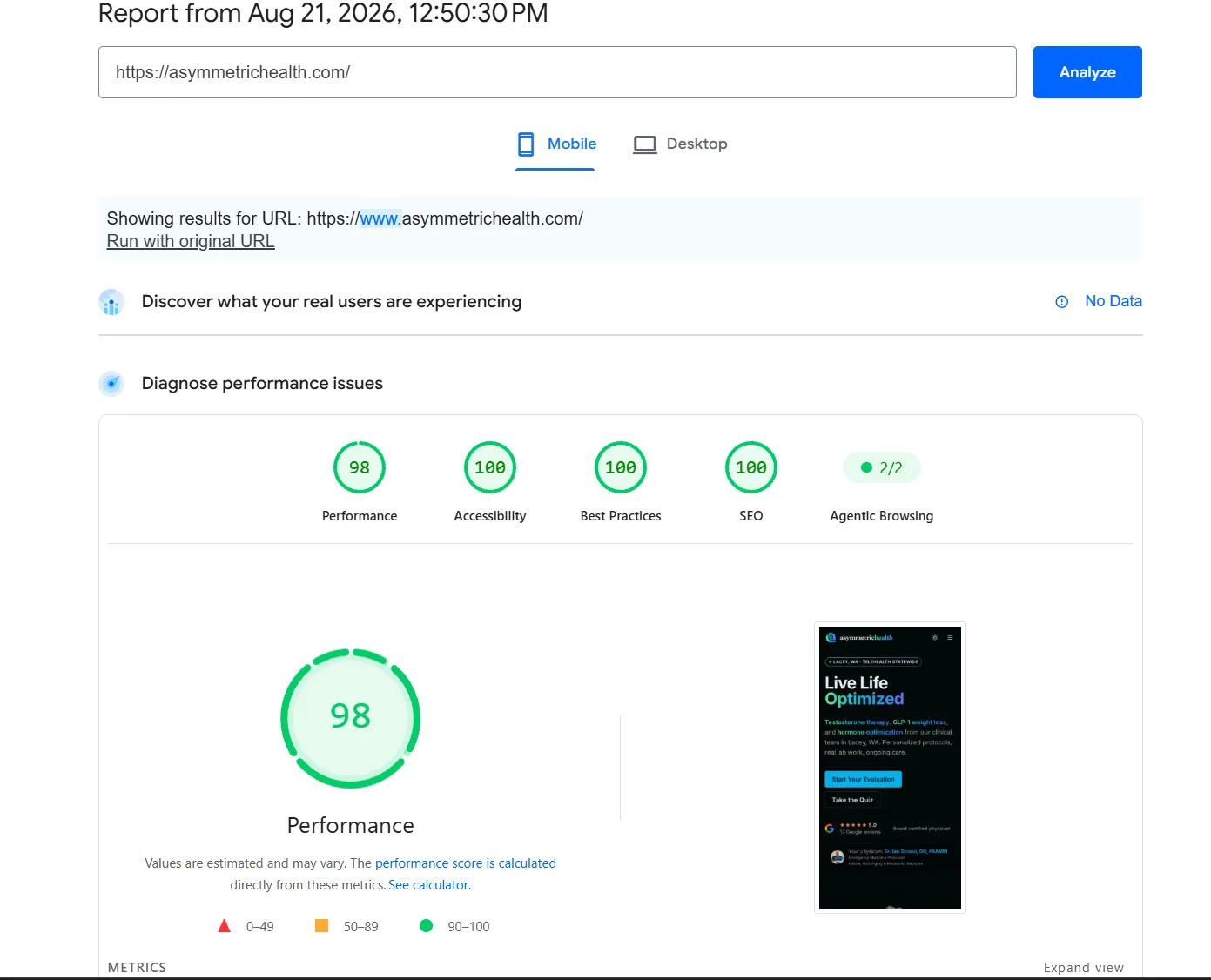
You can run PageSpeed Insights, Google's public speed test, on your own site right now. The mobile test is the harder one: Google slows the network and processor to imitate a mid-range phone on a cellular connection, the way most patients first see a clinic. Asymmetric Health's hand-coded site, tested on 21 August 2026, scored 98 for performance and 100 for accessibility, best practices, and SEO.

Healthcare website design that connects to the clinic
How the Website Hands Off to Your EHR
On the Asymmetric Health site, a patient who wants an evaluation buys it right on the page, and that checkout is Hint's, the clinic's EHR, which we connected the site to: the membership is created there, not with us. Every form still carries attribution, so the inquiry can be counted by date and source.
Every inquiry, attributed by source
How the 156 Patient Inquiries From April Through August 2026 Broke Down by Source
- 88
- arrived as website form inquiries
- 31
- arrived as evaluation bookings
- 14
- came from paid ads
- 22
- added by the clinic from its own records
Inquiry tracking, April through August 2026
Inquiry tracking, April through August 2026
Inquiry tracking, April through August 2026
Inquiry tracking, April through August 2026
What a medical website design build includes
What a Medical Website Design Build Includes, and What It Costs
You want the page list before you sign anything, so we start with the free SEO report: the condition, treatment, and town searches patients near you actually type, and which ones your current site can and cannot already rank for. That becomes the plan.
From there we write every page with your clinicians: a plain definition up top, the physician's byline, the price if you publish one, and an FAQ. The build also covers the bios, the appointment path on every page, MedicalClinic and Physician schema, forms and analytics, the EHR and CRM connections, hosting setup, and launch with a full redirect map.
Accessibility Is a Design Requirement
The Department of Justice has said the ADA applies to the websites of businesses open to the public, and a clinic is one. We build to WCAG 2.2 AA: contrast you can read in sunlight, every control reachable by keyboard, every form field labeled, alt text on every image. It is also why the Asymmetric Health site scores 100 for accessibility.
You Own Everything We Build
The code, the content, the domain, the Google Business Profile, and the analytics are yours from the day the site goes live. There is no theme license to renew and no proprietary platform holding the pages hostage. If you ever leave, the whole site leaves with you.
Priced by scope, locations, and how contested your market is. A written quote follows the free report.
Scope
What you treat sets the page count
Locations
Each location is its own local program
Competitiveness
Who already holds the results sets the pace
Medical website design in practice
Two Months After the Rebuild Went Live, the Clinic Was Top-Ranked for Its Priority Searches
Asymmetric Health is a physician-led Direct Primary Care clinic specializing in TRT, GLP-1-assisted medical weight loss, and BHRT in Lacey, WA. We replaced its WordPress site with a hand-coded build in April 2026, connected the site to the clinic's Hint checkout with source attribution, and ran the SEO program on top. Total visits are 2.8x, with paid social running in some months.
- 500+ patients, 5.0-star Google rating
- Cited first by Google's AI Overview, by name, with its pricing
- Top of the map pack in Olympia for TRT and BHRT searches
- In-person care in Lacey, WA, plus telehealth across Washington
98
mobile PageSpeed performance score
100
for accessibility, best practices, and SEO on the same report
88
website form inquiries from April through August 2026, counted by date and source
127%
more monthly organic visits from Google than the old site
Our medical website design process
How a Medical Website Design Project Runs From First Call to Launch
-
Free SEO Report and a Phone Test of Your Current Site
We run your site through PageSpeed Insights on mobile, check what your forms send and where, list the pages Google has not indexed, and pull the searches in your market. You get a plain recommendation before anything is signed.
-
Plan the Pages Around Your Market
One page per condition, treatment, and town, in priority order by what patients near you actually search. The plan also maps a redirect for every URL on the old site.
-
Write With Your Clinicians
Each page opens with a plain definition, names the physician, states the price if you publish one, and ends with an FAQ. We draft, your clinicians correct, and nothing goes live without their sign-off.
-
Code, Connect, and Test
Taylor Rupe hand-codes the site, connects the site to your EHR's checkout with source attribution, adds the schema, and checks every page for accessibility and speed on a phone before you see it.
-
Launch, Redirect, and Start the Program
Old URLs redirect, the sitemap goes to Google, the Business Profile points at the new pages, and month one of the SEO program begins the same week.
Medical website design questions
Questions Physician-Owners Ask About Medical Website Design
Pair Medical Website Design With
Medical SEO Services
Rank your clinic for the condition, treatment, and near-me searches that book appointments.
Read moreLocal SEO for Medical Clinics
Win the three-clinic map pack and keep the profile that takes most of the phone calls.
Read moreAI SEO for Medical Clinics
Get your clinic named when a patient asks ChatGPT or Google's AI Overview who to see.
Read moreSources & data
- Asymmetric Health: the Lacey, WA clinic behind every performance figure on this page; hand-coded rebuild live April 2026.
- Google PageSpeed Insights: asymmetrichealth.com, mobile, 21 August 2026: 98 performance, 100 accessibility, 100 best practices, 100 SEO.
- Inquiry tracking for Asymmetric Health: new leads from the clinic's own records, by month and source; 156 inquiries, April through August 2026: 88 website forms, 31 evaluation bookings, 14 from paid ads, 22 added by the clinic, and 1 with no source recorded.
- Google Analytics 4 for asymmetrichealth.com: monthly averages, October 2025 to January 2026 versus June to August 2026; organic visits are Google organic sessions by source and medium, paid excluded; paid social ran in some months.
- Google Search captures: the clinic's priority searches, July 2026, 2 months after the rebuilt site went live.
- web.dev, Core Web Vitals: the passing thresholds: Largest Contentful Paint within 2.5 seconds, Interaction to Next Paint of 200 milliseconds or less, Cumulative Layout Shift of 0.1 or less.
- Google Search Central, Core Web Vitals: how Google uses page experience and Core Web Vitals in its ranking systems.
- ADA.gov, Guidance on Web Accessibility and the ADA: the Department of Justice's position that the ADA applies to the websites of businesses open to the public.
- W3C, Web Content Accessibility Guidelines 2.2: the accessibility standard we build to, at level AA.
- Schema.org: the MedicalClinic and Physician types used on clinic pages.
- Astro: the framework every clinic site we build is coded in; pages ship as static HTML.
- Cloudflare: where the finished site is hosted and served from.
Find Out What Your Clinic's Website Does on a Phone Before You Rebuild It
Send us your website and your city. We will test it on mobile the way Google does, check where your forms send what patients type, list what is not indexed, and put it all in your free SEO report with a plain recommendation.
Independent clinics only · SEO and AI search · Remote, clinics nationwide