AI SEO for medical clinics
AI SEO for Medical Clinics: Get Your Clinic Named in Google's AI Overview and ChatGPT
Picture a patient near your clinic, asking ChatGPT or Google who treats this and what it costs. The answer names two or three clinics, in the AI's own words, before a single link even loads. We write and mark up your pages so yours is one of the names, then we count every inquiry that follows.

- ChatGPT visits a month to one clinic on the program
- 30 ChatGPT visits a month to one clinic on the program
- from launch to named in Google's AI Overview
- 2 months from launch to named in Google's AI Overview
- patient inquiries from April through August 2026, counted by date and source
- 156 patient inquiries from April through August 2026, counted by date and source

AI SEO for medical clinics, measured
What AI Search Is Already Doing for One Clinic on the Program
- 30
- visits a month from ChatGPT to one clinic on the program
- 135
- ChatGPT visits since the rebuilt site went live
- 2 months
- from launch to named in Google's AI Overview
- 156
- patient inquiries from April through August 2026, counted by date and source
Google Analytics 4, June to August 2026
Google Analytics 4, since April 2026
Google Search captures, July 2026
Inquiry tracking, April through August 2026

AI SEO for medical clinics, defined plainly
What Is AI SEO for Medical Clinics?
AI SEO for medical clinics is the work of improving a clinic’s website and Google Business Profile so that AI search tools (Google’s AI Overview, ChatGPT, Perplexity, and Bing Copilot) name the clinic, quote its pages, and link to it when a patient asks a question those tools answer directly. The outcome is a clinic named inside the answer, before the patient sees a single link.
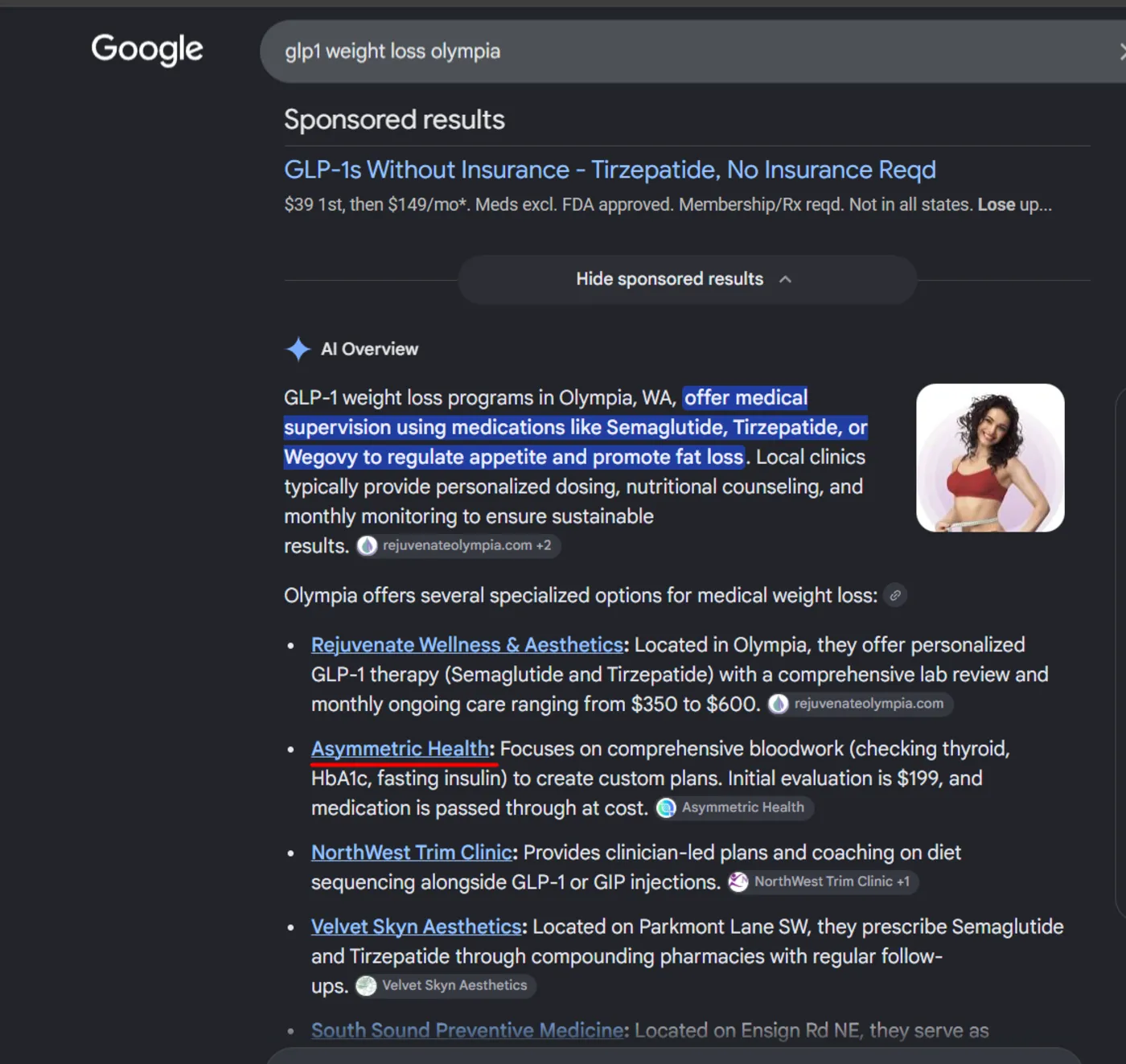
A typical question it wins is “GLP-1 weight loss Olympia”, which Google now answers with an AI Overview that names clinics and quotes their pricing. Underneath, the mechanism is the same as classic SEO: a fast, indexable site and a complete Google Business Profile. What changes is what sits on top of each page, and that is the part most clinic sites are missing.
AI SEO
The umbrella term, and the one most clinic owners use. It covers everything that gets a clinic named and linked inside an AI-generated answer, on Google or anywhere else. On this site it means the AI search work inside the program: definitional writing, authorship, pricing, schema, FAQ markup, and sources.
GEO: Generative Engine Optimization
The academic name for the same work, coined for engines that write a fresh answer every time, like ChatGPT, Perplexity, and Gemini. GEO is about getting quoted inside the generated text rather than listed under it. In practice, the page that does it is the same page.
AEO: Answer Engine Optimization
The older name, from the featured-snippet years. AEO means being the direct answer to a question: one clear sentence, a heading shaped like the question, FAQ markup underneath. It is still the foundation the newer engines build on, which is why we start there.
The three names describe one job, and we run it as one part of the program instead of three.
A page written plainly enough for Google’s AI Overview to quote is the same page ChatGPT cites.
Why AI SEO matters for a medical clinic
Patients Now Ask the AI a Question Before They Ever See Your Clinic's Listing
Type a treatment and a city into Google and the first thing on the page is often an AI Overview: a few paragraphs naming clinics, quoting prices, linking out. Ask ChatGPT and you get the same. Get named in that answer and you have the patient's attention before the map pack even loads. Miss it, and you're hoping they keep scrolling.

A named clinician explaining care in person is the authorship signal an AI health answer looks for.
AI Answers Are Built From Specific Pages
An AI answer is assembled from sentences lifted off specific pages, so the clinic with the clearest page gets the mention. That is good news for an independent clinic, because a clear page is something you can publish this month.
Health Answers Lean on a Named Clinician
Google treats health content as Your Money or Your Life, and its AI features inherit that standard: a real clinician's name, credentials, and a page that says who wrote it. An independent clinic with a physician on staff has that asset already. Most clinic sites never put it on the page.
Every Treatment Question Carries a Cost Question
Patients asking an AI about a treatment tend to ask what it costs in the same breath, and the engine quotes the clinic that published a number. Asymmetric Health publishes its evaluation pricing, and Google's AI Overview quotes it by name.
How AI SEO for medical clinics works
How a Patient’s Question Turns Into an AI Answer That Names Your Clinic
It helps to see the whole chain, because every link in it is something we can build for. Take a real question: a patient near Olympia, WA asks Google or ChatGPT who offers GLP-1 weight loss nearby and what an evaluation costs.
-
The Patient Asks a Whole Question, Not a Keyword
“Who does GLP-1 weight loss near Olympia and what does an evaluation cost?” is a sentence, not the two-word search of a few years ago. The engine splits it into parts it can look up: the treatment, the place, and the cost.
-
The Engine Pulls Candidate Pages From a Web Index
Google’s AI Overview reads from Google’s own index. ChatGPT, Perplexity, and Bing Copilot run their own searches against the web. Either way, a page that is not indexed, or loads too slowly to be crawled well, is never in the running. That is the classic SEO layer, and it still comes first.
-
It Picks Passages That Answer Plainly From Pages It Can Trust
The engine wants a sentence that answers the question on its own, sitting on a page that says who wrote it and what the clinic is. Structured data (MedicalClinic, Physician, FAQPage) tells it those things in a form it reads without guessing.
-
It Writes the Answer and Names Its Sources
The clinic gets named, linked, and, if it published a price, quoted. That link is where the ChatGPT visits in our analytics come from. The patient reads the answer, sees a real clinic with a real doctor and a real price, and clicks through already half decided.
What a Clinic Page Needs Before an Engine Will Quote It
| What the page needs | Why the engine cares | How we build it |
|---|---|---|
| A plain definitional first sentence | It lifts one sentence that answers the question by itself | Every treatment and condition page opens with the term, what it is, and who it is for |
| Named clinicians | Health answers weight authorship; an anonymous page gives it nothing to trust | A byline on each page and a profile page per clinician, marked up as Physician |
| Transparent pricing, where the clinic publishes it | Cost is the question attached to every other question, and a stated number gets quoted verbatim | We publish exactly what the clinic publishes, nothing more, and mark it up as an offer |
| MedicalClinic and Physician schema | Tells it what the entity is, where it is, and who works there, without inference | One structured-data graph per page, matching the Google Business Profile and the directories |
| FAQ markup | Question-and-answer pairs match how patients ask, and AI answer engines lift them directly into a response | Six to eight real questions per page with plain answers, marked up as FAQPage |
| A visible sources block | Engines weight pages that show where their facts come from | Every page cites its sources where the reader can see them, the way this one does |
None of this is exotic. It is careful writing and clean markup, done on every page rather than the homepage alone, and it is the part most clinic sites skip.
AI SEO for medical clinics, live
What It Looks Like When Google’s AI Overview Names a Clinic and Quotes Its Price
Olympia, WA is the larger city next door to Lacey, and Asymmetric Health has no office there. Its GLP-1 weight loss page was written the way the table above describes. Two months after the rebuilt site went live, Google’s AI Overview for a GLP-1 weight loss search in Olympia named the clinic and quoted its evaluation pricing.
AI search and Google rankings from one page
The Same Page Ranks in Google and Gets Quoted by the AI Answer Above It
Owners sometimes ask whether they should put money into AI search instead of Google rankings. It is the same money. Google's AI Overview quotes pages from the same index that ranks the regular results, and ChatGPT cites pages it can find and read. A treatment page that is fast, indexed, plainly written, and marked up does both jobs at once.
For Asymmetric Health, the searches “GLP-1 Lacey WA”, “semaglutide Lacey WA”, and “BHRT Olympia WA” each show the clinic top-ranked organically and named in Google's AI Overview. That is two mentions on one results page from one piece of writing, and it is what the program is built to repeat, treatment by treatment.
Old site, October 2025 to January 2026
~5
visits a month from ChatGPT
New site, June to August 2026
30
visits a month from ChatGPT
Those visitors arrive already knowing the clinic's name, its doctor, and its price. Google Analytics 4 for asymmetrichealth.com, monthly averages; 135 ChatGPT sessions since the April 2026 launch.
Healthcare SEO agency, 2026
What a Healthcare SEO Agency Has to Do Differently in 2026
“Healthcare SEO agency” is searched about 1,600 times a month in the US, which tells you how many clinic owners are shopping for this right now. The work they are buying has changed. Ranking a page is no longer the finish line; the page has to be quotable too, and health pages are held to a higher standard than nearly any other kind.
Four things the medical part changes, and how we handle each on every account.
Every Page Says Which Clinician Stands Behind It
Google's quality guidelines treat health content as Your Money or Your Life, and the AI features inherit that. Each page carries a clinician byline and links to a profile page marked up as Physician, with credentials that match what the Google Business Profile and the directories already say.
Facts About the Clinic, Never Promises About Results
A quotable page describes what the clinic offers as facts (offers GLP-1-assisted medical weight loss, with in-person evaluations in Lacey, WA), never as a claim about outcomes. That keeps the clinic on the right side of its regulators, and it happens to be exactly the kind of sentence the engines lift.
Your EHR Stays Yours
AI search brings visitors who arrive with a specific question. The form they land on captures contact details and nothing clinical, and the inquiry is counted by date and source. Asymmetric Health runs that way today.
A Page per Treatment, Written to Be Lifted
An AI answer to a GLP-1 question quotes a GLP-1 page. A services page that lists twelve treatments in one paragraph gives the engine nothing to lift. So the program builds one page per condition and treatment, each with its own definition, clinician, FAQ, and schema.
The schema, speed, and indexing work is done by Taylor Rupe, our Co-Founder and CTO and a software engineer, not handed to a plugin. Michael Rupe, our Founder and CEO, has done SEO since 1999 and sets the strategy. You work with both of them directly.
AI SEO for medical clinics in practice
Two Months From a Rebuilt Website to Named in Google's AI Overview
Asymmetric Health is a physician-led Direct Primary Care clinic specializing in TRT, GLP-1-assisted medical weight loss, and BHRT in Lacey, WA. We rebuilt its WordPress site as a hand-coded build in April 2026, wrote its treatment pages to be quoted, and marked every one up with MedicalClinic, Physician, and FAQ schema. Visits from Google are up 127%, and ChatGPT is now a steady referrer.
- 500+ patients, 5.0-star Google rating
- Cited first by Google's AI Overview, by name, with its pricing
- Top of the map pack in Olympia for TRT and BHRT searches
- In-person care in Lacey, WA, plus telehealth across Washington
30
visits a month from ChatGPT
135
ChatGPT visits since the rebuilt site went live
156
patient inquiries from April through August 2026, counted by date and source
2 mo
to named in Google's AI Overview for its priority searches
Our AI SEO process for medical clinics
How We Get a Medical Clinic Named in AI Answers, Step by Step
-
Ask the Engines What They Say About Your Market Today
We run your patients' real questions through Google's AI Overview, ChatGPT, and Perplexity, record which clinics get named and which pages get quoted, and hand you that as part of the free SEO report.
-
Fix the Layer Underneath: Indexing, Speed, and the Profile
An engine cannot quote a page it never crawled. We make sure every page is indexed in Google and Bing, loads fast on a phone, and matches the Google Business Profile and the directories on name, address, and clinicians.
-
Rewrite the First Sentence of Every Treatment Page
Each page opens with a plain definition, names the clinician, and states the price the clinic publishes. This is the part the engines lift, so it gets the most care.
-
Add the Structured Data and the FAQ
MedicalClinic and Physician schema on the clinic and its people, FAQPage markup on the questions, and a visible sources block, on every page, so the engine reads the facts instead of inferring them.
-
Count the Visits and the Inquiries Every Month
Referrals from ChatGPT and Perplexity show up in analytics by name. AI Overview mentions we check by hand for your priority searches and save the captures. You get both in the monthly report, next to the inquiry count.
AI SEO for medical clinics questions
Questions Physician-Owners Ask About AI SEO for Medical Clinics
Pair AI SEO for Medical Clinics With
Medical SEO Services
Rank your clinic for the condition, treatment, and near-me searches that book appointments.
Read moreLocal SEO for Medical Clinics
Win the three-clinic map pack and keep the profile that takes most of the phone calls.
Read moreMedical Website Design
Hand-coded by a senior software engineer, fast on a phone, and built so every treatment page can rank.
Read moreSources & data
- Asymmetric Health: the Lacey, WA clinic behind every performance figure on this page; rebuilt site live April 2026.
- Google Analytics 4 for asymmetrichealth.com: monthly averages, October 2025 to January 2026 versus June to August 2026; ChatGPT referrals about 5 a month on the old site and 30 a month on the new site, 135 ChatGPT sessions since launch; organic visits are Google organic sessions by source and medium, paid excluded; paid social ran in some months.
- Inquiry tracking for Asymmetric Health: new leads from the clinic's own records, by month and source; 156 inquiries, April through August 2026: 88 website forms, 31 evaluation bookings, 14 from paid ads, 22 added by the clinic, and 1 with no source recorded.
- Google Search captures: GLP-1 weight loss Olympia and the clinic's other priority searches, July 2026; AI Overview mentions are checked by hand and saved as captures.
- DataForSEO, Google US, September 2026: monthly US searches for healthcare SEO agency (1,600).
- Google Search Central, AI features and your website: Google's guidance for site owners on how AI Overviews and AI Mode choose and link the pages they cite; standard indexing and quality practices apply.
- Schema.org, FAQPage: the structured-data type for the question-and-answer pairs on each clinic page.
- Google Search Central, FAQ structured data: carries Google's deprecation notice for the FAQ rich result, which stopped appearing in Search on May 7, 2026. The markup still matters because AI answer engines read it directly.
- Schema.org, MedicalClinic: the structured-data type for the clinic entity on every page.
- Schema.org, Physician: the structured-data type for each clinician's profile page.
- Google Search Quality Rater Guidelines: health pages are Your Money or Your Life content, held to a higher bar for expertise and authorship.
- Our clinic engagement history: the three-to-six-month organic movement window is our own observed range across clinic and healthcare engagements, not a published benchmark.
Find Out Which Clinic the AI Answer Names in Your Market Today
Send us your website and your city. We will run the questions your patients ask through Google's AI Overview and ChatGPT, show you which clinics get named and why, and tell you plainly what your pages need. The report is free.
Independent clinics only · SEO and AI search · Remote, clinics nationwide