Google Ads for medical clinics
Google Ads for Medical Clinics That Fill the Schedule While the SEO Work Compounds
You cannot wait for the SEO to kick in when the schedule is thin. We run Google Ads for our SEO clients: the ad holds the top of Google for searches you have not ranked for yet, and comes down as the organic rankings arrive. It lands on the treatment page we built, the inquiry is counted by date and source, and you see what each dollar bought.

- average cost of one Google Ads click on a primary care search
- $12.29 average cost of one Google Ads click on a primary care search
- patient inquiries from April through August 2026, each tagged by source
- 156 patient inquiries from April through August 2026, each tagged by source
- more monthly organic visits from Google once the organic work took hold
- 127% more monthly organic visits from Google once the organic work took hold

What Google Ads for medical clinics costs and produces
What a Click Costs, and What Comes Back for It
- $12.29
- average cost of one click on a primary care doctor Phoenix search
- $40.58
- high top-of-page bid for a weight loss clinic Charlotte search
- 156
- patient inquiries from April through August 2026 for one clinic, each tagged by source
- 127%
- more monthly organic visits from Google once the organic work took hold
DataForSEO, Google US, September 2026
DataForSEO, Google US, September 2026
Inquiry tracking, April through August 2026
Google Analytics 4, June to August 2026
Medical PPC, defined plainly
What Is Medical PPC?
Medical PPC (pay-per-click advertising for a medical practice) is buying a spot at the top of Google's results for a search a patient types, and paying Google each time someone clicks it. The clinic chooses the searches, the towns, the hours, and the daily budget. Google shows the ad above the map pack and the organic listings, and the bill is the clicks.
Take “urgent care Phoenix”, typed about 2,900 times a month. A click on that search averages about $4.10. Owners also call this healthcare PPC, Google Ads for doctors, or paid search, and it is the same work under every name. The medical part is Google's healthcare and medicines policy, which every health advertiser is held to, and the need to count each inquiry without touching the patient's information.

Google Ads for doctors on the SEO program
Why We Run Google Ads for the Clinics on Our Medical SEO Program
Your organic rankings are the real asset, and the ad is just the bridge to them. Profile work usually moves in four to eight weeks, and organic pages take three to six months in our engagements, so for that first stretch your schedule needs another source. That is where the ad earns its keep. After that, the two start feeding each other.
The Ad Is Live in Week One
A search campaign can sit at the top of Google inside a week, on the exact treatment searches the clinic wants. While the condition pages we write are still climbing, the ad is already taking the calls those pages will take later.
One Landing Page, One CRM, One Report
The ad lands on the treatment page we built for the organic ranking, and the inquiry is counted alongside the organic ones. No second agency, no second dashboard, and no argument over which channel gets credit for the appointment.
The Search Terms Tell Us What to Write Next
Google shows us every real search that triggered the ad, which is the best keyword research a clinic can buy. A search that converts on paid gets its own organic page. A search the clinic starts ranking for gets its ad budget moved to the next one.
What medical PPC costs per click
What a Single Click Costs a Clinic in Google Ads Right Now
A click is the unit Google sells, so you should know the price before you buy one. These are the current averages for seven patient searches in the cities where we work, with the range Google's own bid estimates run between. Look at the Charlotte weight-loss row: holding the top of the page there runs about 3.7 times the average click.
| Patient search | Monthly searches | Average cost per click | Top-of-page bid, low to high |
|---|---|---|---|
| urgent care Phoenix | 2,900 | $4.10 | $1.96 to $6.08 |
| primary care doctor Phoenix | 1,000 | $12.29 | $3.96 to $13.47 |
| primary care doctor Denver | 720 | $9.47 | $3.54 to $13.71 |
| weight loss clinic Miami | 720 | $10.61 | $6.33 to $28.74 |
| weight loss clinic Atlanta | 590 | $19.22 | $10.53 to $37.63 |
| weight loss clinic Tampa | 590 | $15.31 | $7.65 to $34.68 |
| weight loss clinic Charlotte | 390 | $11.04 | $7.85 to $40.58 |
DataForSEO, Google US, September 2026. Google's live auction moves daily; these are the planning figures we start from, and we pull yours during the free SEO report.
Put it in clinic terms. A hundred clicks on “primary care doctor Phoenix” costs about $1,229 at the average. Whether that was a good month depends on one number Google's report never shows: how many of those hundred people became patients. That is the number we build the account around, and it is why the next two sections exist.

Healthcare PPC and Google's ad policies
Google's Healthcare Ad Policies Shape How a Clinic's Campaign Gets Built
An account suspended mid-month is usually how you would first learn Google treats health advertising differently from plumbing or law. Built around the rules from day one, they become an advantage: the campaign stays aimed at the one signal Google still lets you use freely, the search itself.
Prescription Drug Terms Under the Healthcare and Medicines Policy
Google's rule
Google restricts the promotion of prescription drug services and the use of restricted drug terms in ads, keywords, and landing pages, and advertisers must apply before running ads that involve prescribing. Its list of unapproved substances includes hCG, which matters to a weight-loss clinic.
How we build around it
We write the ad around the visit, not the drug: the evaluation, the labs, the clinician, the town. Restricted drug terms stay out of the ad text and the keyword list, and when a service line needs Google's healthcare certification, we file it with you before launch.
LegitScript Certification for Pharmacies and Prescribing Telehealth
Google's rule
In the United States, Google allows online pharmacies to advertise only with LegitScript certification or NABP accreditation, and it allows telemedicine providers only with LegitScript's Healthcare Merchant Certification. The rule names websites that deliver virtual care and facilitate prescribing.
How we build around it
Whether your clinic falls inside that definition depends on how much of your prescribing happens over telehealth. We check your service lines against the policy before the first ad runs, and if a certification applies, we walk through the application with you rather than finding out from a disapproval.
No Remarketing on Health Interest
Google's rule
Google's personalized advertising policy lists health as a sensitive interest category. Advertisers promoting health services cannot use advertiser-curated audiences, the lists a business builds from its own site visitors or customer data instead of Google's predefined audiences.
How we build around it
So a clinic cannot follow a visitor around the web after they read the TRT page, and honestly it should not want to. The whole budget goes into search campaigns, where the patient tells Google what they need by typing it, and the landing page and the phone answer are made good enough that there is nothing to chase.
Conversion Tracking That Counts Inquiries
Google's rule
The same personalized advertising policy bars passing personally identifiable information through Google's tags and data segments. A clinic has patient privacy sitting on top of that, so the tracking has to be designed, not bolted on.
How we build around it
The conversion we count is the event, never the person: a call, a form submission, an evaluation purchase. Every inquiry is counted by date and source. Asymmetric Health has run that way since launch.
Add it up and the campaign structure writes itself. Call-focused search campaigns, one per service line, with location assets, call assets, and an ad schedule that matches the clinic's hours, so the ad shows the address, the phone number, and the open hours to someone who can actually get in today.
A long negative keyword list keeps the budget away from job seekers, students, and people searching a medication name to buy it online.
Where Google Ads for medical practices hand off to SEO
The Search Where the Ad Budget Gets to Move On
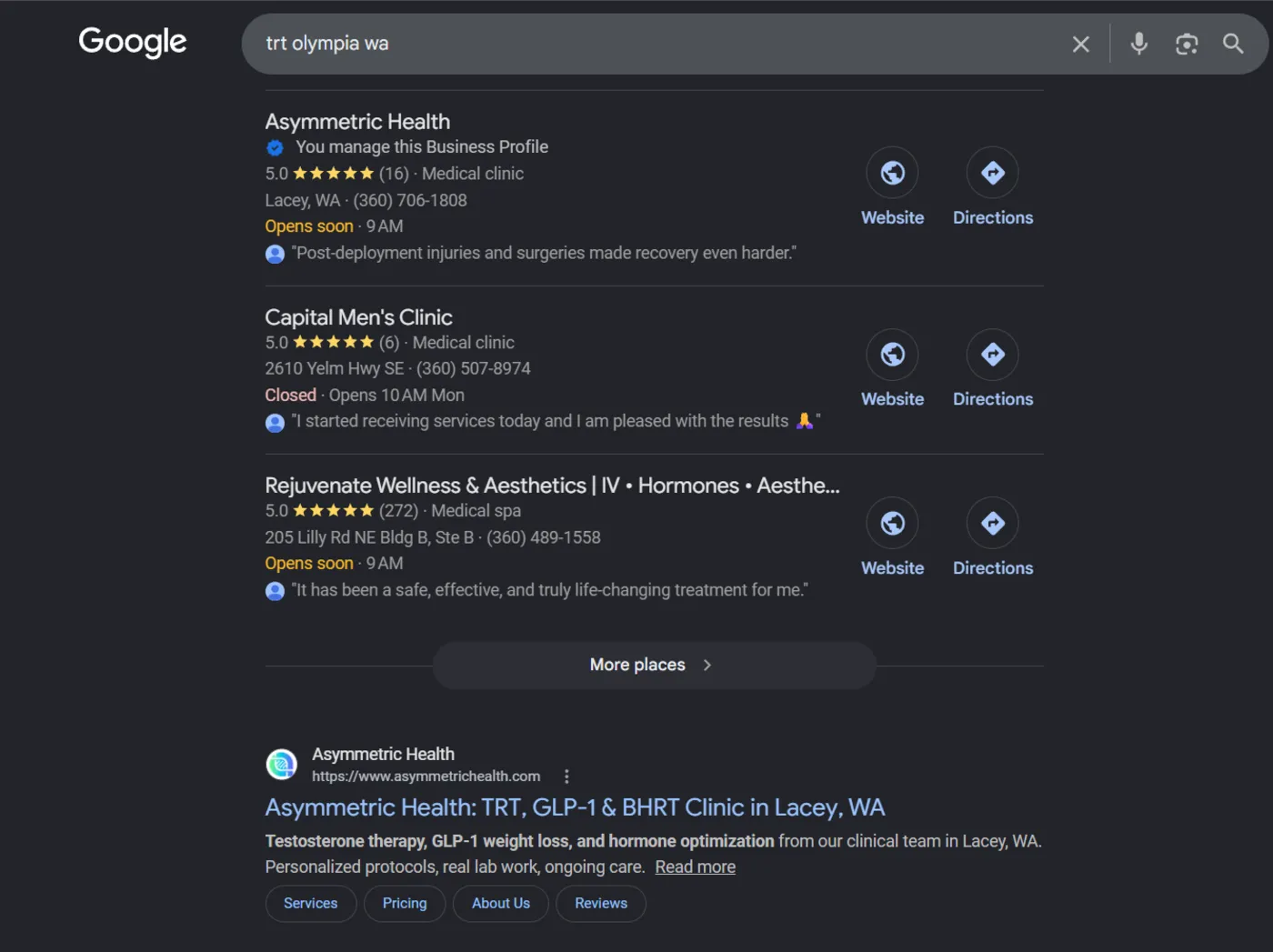
This is what the handoff looks like. Asymmetric Health holds the top of the map pack in Olympia, WA for TRT searches, ahead of clinics located in Olympia, with its own page in the organic results below. On a search like this the free placements already carry the clinic, so the ad budget belongs on the searches it has not won yet.
Medical PPC reporting
Why Our Medical PPC Reports Count Patient Inquiries Instead of Clicks
Google's own report is built for Google: impressions, clicks, click-through rate, cost per click. None of those is a patient. A campaign can post a great click-through rate while every click bounces off a slow page, and the report still looks like a win. So we count inquiries instead, logged by source with a date and nothing clinical.
How Asymmetric Health’s 156 Inquiries Broke Down From April Through August 2026
88
website forms
31
evaluation bookings
14
from paid ads
22
added by the clinic from its own records
Inquiry tracking, April through August 2026.
That last count is the whole point of the report. You see what the ad bought that month sitting right next to what the organic work brought in, and the budget conversation gets short. A speed score matters here too: the ad lands on the hand-coded site that scored 98 on mobile PageSpeed, so the click you paid for does not bounce.
Google Ads stays a separate line on your invoice because the spend goes to Google. The management, the treatment pages the ads land on, and the counting are ours, and they are the same people doing the SEO.
Google Ads and medical SEO on one account
Two Months From a Rebuilt Website to Top-Ranked, With Every Inquiry Tagged by Source
Asymmetric Health is a physician-led Direct Primary Care clinic specializing in TRT, GLP-1-assisted medical weight loss, and BHRT in Lacey, WA. We rebuilt its WordPress site as a hand-coded build in April 2026 and ran the SEO program underneath it, with every inquiry counted by source. Visits from Google grew 127%, and total visits reached 2.8x the old site, with paid social running in some months.
- 500+ patients, 5.0-star Google rating
- Cited first by Google's AI Overview, by name, with its pricing
- Top of the map pack in Olympia for TRT and BHRT searches
- In-person care in Lacey, WA, plus telehealth across Washington
156
patient inquiries from April through August 2026, each tagged by source
98
mobile PageSpeed score on the pages the ads land on
127%
more monthly organic visits from Google than the old site
2 mo
to top-ranked for its priority searches
Our Google Ads process for medical clinics
How We Set Up and Run Google Ads for a Medical Clinic
-
Pull the Cost of a Click in Your Market
The free SEO report includes the searches your patients type, what each click costs in your city, and which of those searches you already rank for. That tells us where an ad helps and where it would only buy clicks you get free.
-
Build the Landing Pages and the Counting First
Each campaign lands on a real treatment page with the clinician's name, the hours, and a click-to-call number. Call and form conversions are counted by date and source before any spend starts.
-
Write the Campaign Inside Google's Healthcare Policies
Call-focused search campaigns, one per service line, ad copy with no restricted drug terms, location and call assets, an hours schedule, and a negative keyword list that starts long. If your service line needs Google's healthcare certification, we handle the application with you.
-
Launch Small, Then Spend Where the Inquiries Are
The first weeks run a modest daily budget so the search terms report can show us what patients actually type. Budget then moves toward the searches that turn into inquiries and away from the ones that only produce clicks.
-
Report Inquiries Monthly and Move Budget as Rankings Arrive
One report a month: inquiries by source, cost per inquiry from the ad, and which searches the organic pages have started to hold. When a page ranks, its ad budget goes to the next search on the list.
Google Ads for medical clinics questions
Questions Clinic Owners Ask About Google Ads for Medical Clinics
Pair Google Ads With
Medical SEO Services
Rank your clinic for the condition, treatment, and near-me searches that book appointments.
Read moreLocal SEO for Medical Clinics
Win the three-clinic map pack and keep the profile that takes most of the phone calls.
Read moreAI SEO for Medical Clinics
Get your clinic named when a patient asks ChatGPT or Google's AI Overview who to see.
Read moreSources & data
- Asymmetric Health: the Lacey, WA clinic behind every performance figure on this page; rebuilt site live April 2026.
- Inquiry tracking for Asymmetric Health: new leads from the clinic's own records, by month and source; 156 inquiries, April through August 2026: 88 website forms, 31 evaluation bookings, 14 from paid ads, 22 added by the clinic, and 1 with no source recorded.
- Google Analytics 4 for asymmetrichealth.com: monthly averages, October 2025 to January 2026 versus June to August 2026; organic visits are Google organic sessions by source and medium, paid excluded; paid social ran in some months.
- Google Search captures: TRT Olympia WA and the clinic's other priority searches, July 2026.
- Google PageSpeed Insights: asymmetrichealth.com, mobile, 21 August 2026: 98 performance.
- DataForSEO, Google US, September 2026: monthly searches, average cost per click, and low and high top-of-page bids for the seven patient searches in the table, including $12.29 per click on primary care doctor Phoenix and a $40.58 high bid on weight loss clinic Charlotte.
- Google Ads policy: Healthcare and medicines: the prescription drug services restrictions, the United States requirements (LegitScript or NABP for online pharmacies; LegitScript Healthcare Merchant Certification for telemedicine providers that facilitate prescribing), and the unapproved substances list that includes hCG.
- Google Ads policy: Restricted targeting in personalized advertising: health as a sensitive interest category, the bar on advertiser-curated audiences for those categories, and the bar on passing personally identifiable information through tags and data segments.
- Google Ads Help: About location assets: how an ad shows the clinic's address, map, and distance.
- Google Ads Help: About call assets: how an ad shows a phone number and counts calls.
- Google Ads Help: Conversion tracking: how a call or form is counted as a conversion after an ad click.
- Our engagement history: the four-to-eight-week and three-to-six-month movement windows are our observed ranges across clinic and healthcare engagements, not a published benchmark.
See What a Click Costs in Your Market Before You Buy One
Send us your website and your city. The free SEO report shows the searches your patients type, what each click costs there, which searches you already hold for free, and where an ad would help while the organic work catches up.
Independent clinics only · SEO and AI search · Remote, clinics nationwide